Contact Us


The Science Behind a Dog’s Nose
By Michael Wynn, Allied Universal® Enhanced Protection Services Director of Canine Training
You walk into the kitchen, listening to all the usual sounds it produces: a burner clicks, water hums, a spoon scrapes the side of a pot. Then, the air changes and you lift your nose. To you, the sudden aroma is simple: spaghetti sauce. One smell, one label. A dog experiences the same moment differently. The “sauce” is not one thing but an amalgamation of unique scents. Tomato, onion, garlic, herbs, and oil—each ingredient has its own unique, invisible aromatic thread.
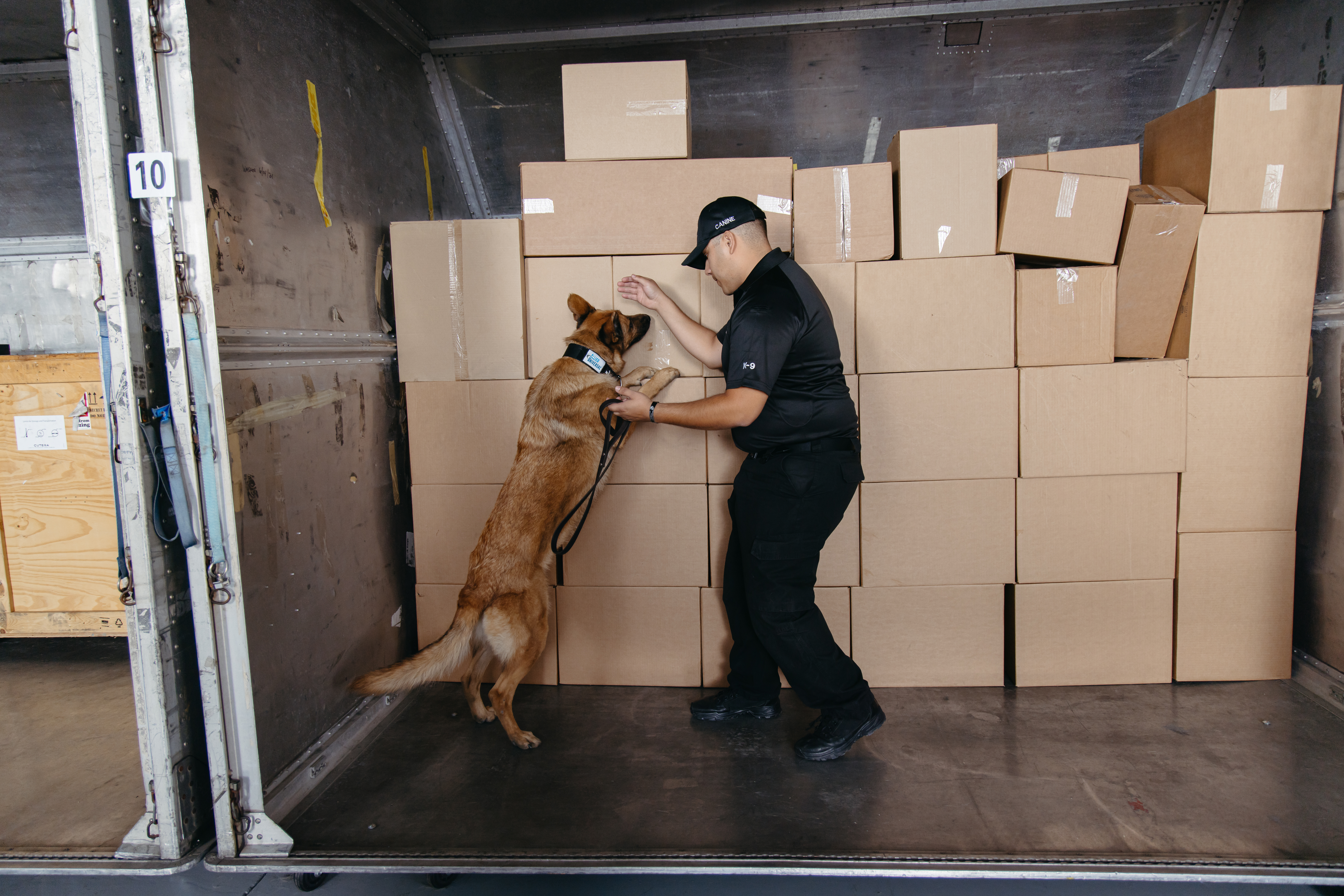
That ability to separate scents into their parts is the starting point for understanding why canine security teams remain such a valued tool in explosives detection work, especially in complex spaces like cargo and freight operations, loading docks, and busy commercial buildings.
Smell Is a Dog’s Primary Data Stream
For dogs, scent is a sophisticated data stream, constantly updated and deeply detailed. Their system is built to gather detailed scent information and process it quickly.
More receptors to capture more signals. Dogs are estimated to have more than 100 million scent receptors in the nasal cavity compared to about 6 million in people.
More surface area to read the air. Dogs have 17 times more smell-detecting tissue than humans.
More brainpower devoted to odor. The area in a canine’s brain used to analyze scent is about 40 times larger than the comparable area in humans.
Some estimates show dogs can detect smells anywhere from 1,000 to 10,000 times more accurately than people. And dogs sample scent actively. Research that models canine sniffing often uses rates of several sniffs per second, helping the dog constantly refresh its palette.
Why This Matters in Cargo, Freight, and Commercial Spaces
Real environments are messy. Cargo and freight spaces carry overlapping odors: cardboard, plastics, fuel, lubricants, cleaning products, food, perfumes, and constant airflow from doors and vehicles. Buildings and venues add their own mix—lobbies, elevators, mailrooms, loading areas, open-air spaces, and corridors where scents travel in unpredictable ways.
This is where the pasta sauce analogy becomes practical. A well-trained detection dog can work through layers. The aim is not for the dog to react to a strong smell—but to recognize a specific odor signature through the scent layers.
That capability can support security needs such as:
Cargo and freight: screening pallets, containers, and staging areas where items move quickly and storage conditions change
Vehicles and loading docks: checking entry points where goods and people share the same flow paths
Commercial spaces: supporting security programs in lobbies, mail and package areas, and other high-traffic zones
The dog is never working alone. A canine security team is a partnership in which the dog reads the environment, and the handler reads the dog. The handler watches for changes in the dog’s behavior that may indicate a credible alert, then follows established site procedures to report concerns and help coordinate next steps.
Training Keeps the Nose Useful
Scent detection is based on repetition, clarity, and consistency.
Canine programs build a dog’s “odor library,” teaching the dog to distinguish relevant odors from background scent. Over time, that library expands as the world changes. As threat profiles evolve, training programs adapt by introducing new target odors in controlled conditions while keeping the safety of the dog and handler at the center of the work.
Scale matters, too. Allied Universal® Enhanced Protection Services operates the largest private-sector canine security program, with over 1,000 teams assigned globally. That reach supports consistent standards across regions and helps clients integrate canine screening into broader security planning, whether the setting is a distribution operation or a multi-tenant commercial building.
Canine detection is applied biology paired with training discipline, used in places where speed, mobility, and adaptability matter.
In the end, the value comes back to that kitchen moment. Humans smell the sauce. Dogs smell what the sauce is made of. In cargo, freight, and commercial environments—where odors overlap and stakes are high—that difference can help support safer operations and help reduce risk, one careful sniff at a time.
About Michael Wynn: Michael Wynn is a retired Connecticut State Trooper who was a Master Trainer and lead instructor for the Connecticut State Police canine program. He has over 35 years of experience training police work dogs and is certified by the New England State Police Accreditation Committee. While working with the Connecticut State Police, he led a task force commissioned by the Department of State to create an EDC Anti-Terrorism Assistance Program to protect at-risk State Department locations worldwide. He is certified as an expert witness in both State and Federal court on matters relating to police work dogs. He is one of the foremost authorities on police working dogs and has spoken on behalf of the Bureau of Alcohol, Tobacco, Firearms and Explosives (ATF) and the United States Police Canine Association on many occasions. He previously served on the Department of Homeland Security’s advisory panel for the Explosives Standards Working Group. This panel is drafting a set of national standards for bomb dog training and operations. He is a member of the International Association of Bomb Technicians and Investigators.
Related Blogs
-
Image

-
Image