Contact Us


Detection Dogs in Modern Security: How Canine Teams Complement Technology Like X-ray and AI
Q&A with Chris Shelton, Vice President, Air Cargo at Allied Universal® Enhanced Protection Services
In enterprise business environments, a successful security program is not determined based solely on the number of solutions deployed, but by how well the overall program addresses real-world risks and vulnerabilities. In dynamic environments like cargo facilities, corporate campuses, and public venues, threats rarely present themselves at predictable checkpoints. Risks shift across space, time, and operational workflows. Organizations must design layered, flexible programs that adapt as conditions change.
Detection dogs continue to play a critical role in modern security programs because they introduce mobility and adaptability that fixed systems cannot replicate. When integrated into a robust program, canine teams expand screening capabilities, support faster resolution, and help maintain operational continuity.
Chris Shelton, Vice President, Air Cargo at Allied Universal® Enhanced Protection Services explains how canine teams fit into a modern, layered approach to security.
With so much focus on AI and advanced screening technology, why do detection dogs still matter?
Most organizational environments are dynamic. Technology is typically deployed at defined checkpoints, but risks are not always so predictable.
Canine teams are able to move across a facility and apply detection where it is needed in real time. This extends screening beyond fixed locations and allows organizations to identify potential risks earlier—before a person, vehicle, or package reaches a more sensitive area.
For security leaders, that shifts coverage design from fixed entry points to distributed detection aligned with operational flow.
What do canine teams add that technology often cannot?
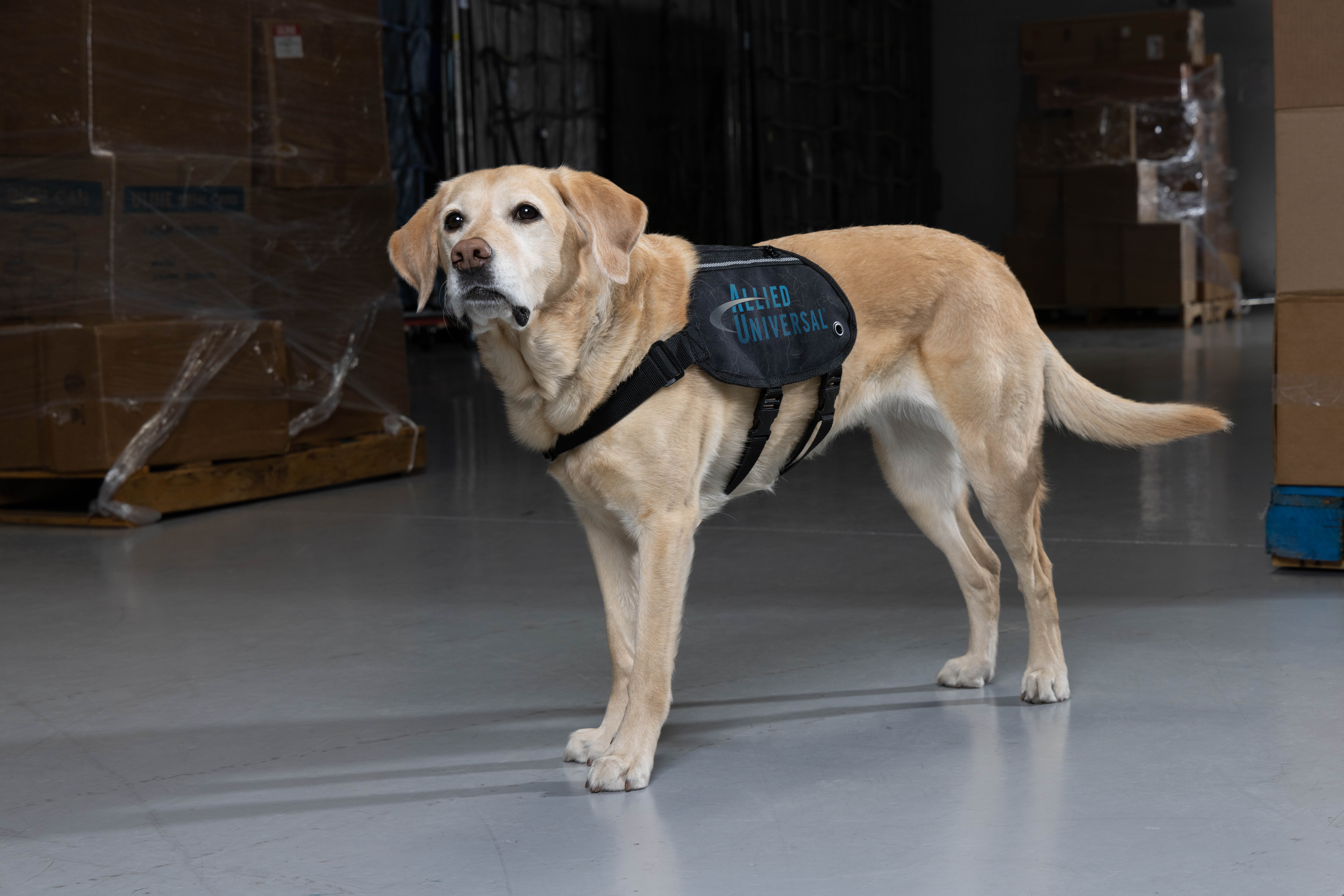
Adaptability under real-world conditions.
If the threat landscape shifts, canine teams can be retrained to address a new threat profile in a relatively short period of time—something not always feasible with fixed detection systems. This versatility becomes exponentially more powerful when considered alongside the canine’s mobility. Once trained on the new threat, they can be repositioned within the facility as vulnerabilities.
I would also note that their presence influences behavior, much more so than other security solutions. Hostile actors have become desensitized to camera systems, access control, and even security personnel. Yet they still hesitate around a canine, especially when they are not sure what type of work that canine is trained to conduct. In many environments, this deterrence factor contributes to risk reduction before an incident ever develops.
How do detection dogs and X-ray complement each other in practice?
Threats do not always appear where screening is concentrated. Incidents such as the Manchester Arena bombing reinforced the importance of extending detection beyond fixed checkpoints into the broader operating environment. Like most venues, the arena had screening in place during entrance, but none in place during egress; this vulnerability was exploited with devastating consequences and the entire industry realized they needed to adjust overnight. A mobile canine team can adjust to these requirements in real time as concerns evolve. It would be expensive and infeasible to achieve these same results with technology.
Air cargo illustrates this well. Canine teams can screen cargo significantly faster than X-ray or explosive trace detection, helping move volume without creating bottlenecks. More than 350 Allied Universal teams are individually TSA certified for these environments, demonstrating how this model operates at scale.
The advantage is not just speed — it is how efficiently a program moves from detection to resolution without disrupting operations. A canine alert does not have to trigger a shutdown. Through our patented Advanced Alarm Resolution process, the item can be routed to X-ray, reviewed through our SmartTech® platform by certified bomb technicians, and resolved in about 90 seconds. The handler coordinates with client stakeholders according to established escalation protocols, enabling a consistent, defensible response.
This is how layered security systems function best: canine teams expand coverage and flexibility, while technology and remote expertise provide the depth needed to resolve uncertainty.
Supporting tools reinforce that process. Our K9-Comply® platform captures screening data in real time, reducing manual workload while maintaining compliance and audit readiness.
What kinds of threats are organizations asking canine teams to address today?
The scope has expanded. While explosives detection remains central, organizations are increasingly adding firearms detection and, in some environments, narcotics detection.
This reflects a broader shift in risk mitigation. Rather than focusing on a single threat, organizations are evaluating how multiple threats could impact operations, safety, and reputation — and seeking capabilities that can adapt accordingly.
Canine teams are effective in this environment because they detect trace amounts of odor, including residual odor that may remain even when an item is concealed, vacuum packed, or surrounded by distracting odors.
What should security leaders evaluate when considering a canine program?
Program discipline is critical.
This includes handler standards, training methodology, certification processes, and how performance is validated over time. Strong programs are defined not just by training, but by consistent performance under real-world operating conditions.
In regulated environments such as air cargo, this also includes alignment with federal requirements, third-party testing, and structured oversight to help ensure performance is both effective and compliant.
The most effective programs align canine teams, technology, and daily workflows. When those elements support each other, organizations can close gaps, respond with less disruption, and maintain consistency as conditions change.
The Bottom Line
Detection dogs are not an alternative to technology — they extend it.
Programs that integrate canine teams with X-ray, AI-supported workflows, and remote expertise gain flexibility and depth, allowing organizations to screen more effectively, respond more quickly, and maintain continuity.
For security leaders, the objective is not to choose between capabilities, but to design a system where each component strengthens the overall security posture.
About the Expert
Chris Shelton is a 17-year veteran with the Federal Air Marshal Service (FAMS), a United States federal law enforcement agency under the supervision of the Transportation Security Administration (TSA) of the United States Department of Homeland Security (DHS). During his tenure with FAMS, Mr. Shelton served as the Supervisory Air Marshal in Charge of the TSA Canine Training Center. He supervised canine team training for the largest explosive detection canine program in DHS and was responsible for training, deploying and evaluating over 1,000 TSA and law enforcement-led canine teams for aviation, multimodal, maritime, mass transit and cargo environments. Mr. Shelton was instrumental in the development and implementation of the Certified Cargo Security Program – Canine (CCSP-K9), the TSA program regulating the use of third-party canine providers for explosive detection screening in regulated air cargo environments. With a long-time passion for security and explosive detection canines, Mr. Shelton began his career with a decade of service as a municipal law enforcement officer.
Related Blogs
-
Image

-
Image
-
Image